Prime Minister Tusk's historic visit to India - what was agreed?
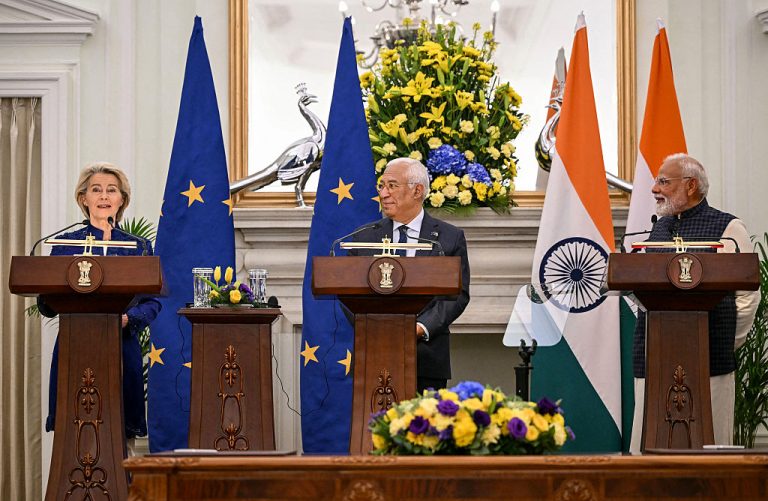
Prime Minister Donald Tusk's visit to India is one of the most important events in Polish-Indian relations in recent years. As the head of the Polish government himself stressed during the joint press conference with Prime Minister Narendra Modi in New Delhi, it is "the largest visit of its kind in the history of relations between the two countries". It was accompanied by a large business delegation, which clearly signals that the economy was, and remains, the foundation of the talks.
Prime Minister Modi of India recalled that since Polish-Indian relations were elevated to a strategic partnership, cooperation between the two countries has accelerated significantly. Both prime ministers took a number of decisions aimed at further strengthening mutual ties - at both the political and economic level.
Modi noted that Polish-Indian friendship is based not only on diplomacy, but also on a shared approach to humanity, warmth and compassion. Tusk, for his part, pointed out that Poland and India have a great deal in common, and the only barrier is geographical distance - the absence of any conflict of interests or negative historical legacy creates exceptionally favourable ground for building a partnership.
Poland as the gateway to Europe - what does it mean for business?
The key message of the visit is a vision in which Poland becomes the gateway to Europe for Indian companies, and India the gateway to Asia for Polish businesses. This is not merely a diplomatic slogan - behind these words are concrete strengths of both economies that can deliver real benefits to companies in both countries.
Prime Minister Tusk listed Poland's main advantages from the perspective of Indian business:
- Developed industry and highly qualified specialists
- Access to the European single market - more than 400 million consumers
- A location at the heart of Europe's transport routes and extensive logistics infrastructure
On the other hand, India brings to the partnership an enormous market scale, growth dynamism, talent and great production potential. Prime Minister Tusk emphasised that the two countries can cooperate in key areas such as defence, energy, agriculture, technology and science.
The geopolitical context further reinforces the importance of these agreements. Because of the war in Ukraine and the fragility of global supply chains for energy, raw materials and technology, Poland must build resilient and diversified trade relationships. In this setting, India appears as a partner of strategic importance - a manufacturing alternative, a source of raw materials and a huge sales market.
Key areas of Polish-Indian cooperation
The prime ministers of both countries identified specific areas in which the partnership is to develop most intensively. The ambition is to double bilateral trade - a goal that both leaders considered fully achievable.
Critical minerals, raw materials and coal gasification
Modi announced the creation of new partnerships in the area of critical minerals and raw materials - resources essential for the energy transition and the development of advanced technologies. Cooperation on coal gasification is in turn a response to the energy needs of both countries, which still rely heavily on this fuel.
Trusted supply chains
The Prime Minister of India expressed the hope that teams from both countries would work together to create trusted supply chains. In an era of global uncertainty - from pandemics to armed conflicts - diversifying sources of supply has become a strategic priority. Poland, with its central position in Europe, and India, as one of the world's largest economies, can complement each other's potential.
Youth exchange and democratic values
Both prime ministers stressed that relations are not limited to trade. The Jamsaheb of Nawanagar Youth Exchange Programme is intended to build ties between successive generations of Poles and Indians. Modi noted that both Poland and India believe in the rule of law and democracy - values that require particular protection in the current times.
Tusk added that the "Solidarity revolution" was based on the idea of acting without violence - an idea close to the Indian tradition - and that Prime Minister Modi's global role is "a sign of hope in times of destabilisation and chaos".
A peace perspective - the position on the war in Ukraine
The conflict in Ukraine was also raised during the press conference. Prime Minister Modi declared: "Let us remember what is happening in Ukraine. We will support every effort towards achieving peace". This is an important signal given India's position, as it maintains relations with both the West and Russia.
For Poland - a country that directly borders Ukraine - India's peace declarations carry an additional security dimension. Tusk stressed that in international forums the two countries will support each other "with full conviction that this is for the good of our countries and for the good of the whole world".
The development of defence cooperation, mentioned by the Polish prime minister, fits into this perspective. Resilient strategic partnerships are not only about trade - they are also about shared security and the ability to respond to geopolitical crises.
What does the visit to India mean for Polish entrepreneurs?
For Polish companies, visits at such a high level are a signal that the Indian market is becoming increasingly accessible. Prime Minister Tusk assured that he would "personally patronise" relations and cooperation between Polish and Indian businesses - Prime Minister Modi made an analogous pledge on the Indian side.
Entrepreneurs interested in expanding into the Indian market should pay attention to several key aspects:
- Legal form of the business - entering the Indian market requires an appropriate structure, e.g. a branch or a subsidiary
- Verification of business partners - in a new market environment, thorough analysis of counterparties is essential
- Regulatory and tax environment - India has a specific tax and administrative system that requires professional support
- International agreements - Poland and India are linked, among other things, by a double taxation treaty, which may allow for effective tax planning
It is worth knowing that Global Tax Partners offers comprehensive support with setting up and running companies in India - from registration and partner verification to ongoing legal and accounting services. This is a solution that can allow a smooth entry into the Indian market without having to build the entire infrastructure from scratch.
Planning to expand into the Indian market? Take advantage of a free consultation
Prime Minister Tusk's visit to India opens a new chapter in the economic relations between the two countries. If you are considering extending your business to the Indian market or looking for alternative supply chains in Asia, it is worth preparing for these changes now.
The specialists at Global Tax Partners help Polish entrepreneurs set up companies in India, verify business partners and plan optimal tax structures - taking into account the specifics of both jurisdictions. Services are provided 100% remotely, and the first consultation is free.
Call +48 505 684 412 or visit globaltax.partners to arrange a conversation. Find out how a properly planned structure can allow your company to enter one of the fastest-growing markets in the world safely.
Have a question about this?
The first consultation is free - let us talk about your situation.