Bank algorithms never sleep - what triggers them?
Many Poles live with the belief that their everyday transfers are too small and too ordinary for anyone to take an interest in them. More than 30 million people make bank transfers - so why would a bank or the Polish Tax Office (urząd skarbowy) pay attention to your transactions in particular? The answer is simpler than it might seem: it is not an official going through bank statements by hand, but advanced analytical algorithms that work non-stop, analysing millions of operations in real time.
As Arkadiusz Lament from our firm points out, banking systems are designed to detect repeated transaction patterns that deviate from the norm. It is not only about one-off transfers of large amounts. Algorithms analyse the frequency of transactions, their regularity, the direction of the flow of funds and links with entities from specific jurisdictions. A few unusual transactions in a short period are enough for the system to automatically flag an account for additional verification.
It is worth understanding that the main purpose of these mechanisms is combating money laundering (AML) and preventing the financing of terrorism. Banks operating in Poland are required under the Anti-Money Laundering Act to monitor their clients' transactions. When an algorithm detects a suspicious pattern, the information may go both to the bank's internal compliance department and to the General Inspector of Financial Information (GIIF), and from there to the Polish Tax Office (urząd skarbowy).
Which transactions raise the most suspicion?
Not every payment means trouble, but certain patterns of behaviour can quickly trigger a bank's security procedures. It is worth knowing what monitoring systems look for, so that you can consciously avoid unnecessary problems.
Splitting amounts into smaller transfers
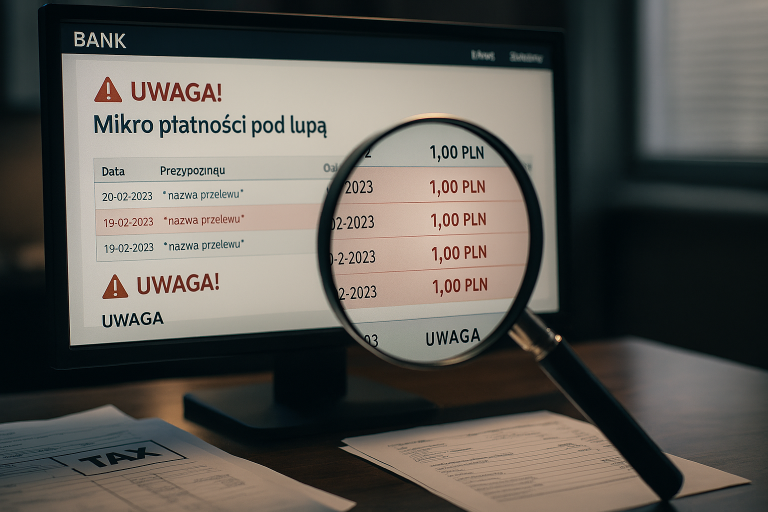
One of the most commonly detected patterns is so-called structuring, that is, dividing one larger sum into several smaller transfers made within a short period of time. Even if you do it unintentionally - for example, because your bank has a daily transaction limit - the algorithm may read this as an attempt to circumvent reporting thresholds or to conceal the source of the money. It is one of the classic warning signals in AML systems.
Frequent card top-ups and foreign payments
Regularly funding prepaid cards or multi-currency cards also attracts the attention of the systems. The situation is similar with payments directed to companies registered in jurisdictions associated with tax optimisation - for example to Dubai companies or other tax havens. Even legitimate purchases from foreign online shops or accommodation bookings abroad may sometimes trigger additional verification if they fit into a broader, unusual pattern.
The most common actions that raise concerns include:
- Splitting a single transfer into several smaller transactions within a short time
- Frequent top-ups of prepaid cards or multi-currency cards
- Regular payments to foreign entities, especially from countries with low tax transparency
- Imprecise or jokey transfer titles that make it impossible to establish the purpose of the transaction
- Sudden receipts of large amounts without a clear economic justification
How to describe transfers correctly and avoid problems
One of the simplest and at the same time most effective rules is to give the transfer title clearly and precisely. The transaction title should immediately show what you are paying for - whether an invoice for a service, a loan instalment or a gift to a family member. Vague descriptions such as "for that thing” or jokes entered in the title field can look suspicious from the banking system's perspective and lead to additional questions.
Arkadiusz Lament advises that you do not split one larger sum into several smaller transfers without need. If you have to pay PLN 15,000, it is safer to do so in a single transfer with a clear title than to make three transfers of PLN 5,000 at intervals of a few hours. A bank algorithm may automatically classify the latter scenario as an attempt to get around reporting limits.
Particular caution is advisable with family gifts. Although tax law provides exemptions for the closest family (the so-called zero group in inheritance and gift tax), using this exemption requires reporting the gift to the Polish Tax Office on form SD-Z2 within 6 months of receiving it. Failure to report may result in tax being charged together with interest, and in extreme cases - a penalty tax rate of up to 20%.
Foreign payments - how to protect yourself with documents
In the age of global e-commerce, more and more Poles are buying from foreign online shops, booking accommodation through international platforms and paying for digital services provided by companies from all over the world. Every such transaction leaves a trace in the banking system and may be subject to analysis.
The best protective strategy is systematic collection of documentation. For foreign purchases, it is worth keeping payment confirmations, invoices, order confirmations and email correspondence with the service provider. If the bank asks you to explain a specific transaction, a complete set of documents will let you confirm quickly and smoothly that the operation was entirely legitimate.
This applies in particular to payments directed to entities from countries regarded as tax havens or high-risk countries. Even if you are only buying electronics from a seller in Dubai or paying for a software subscription from a company registered in Hong Kong, having the invoice and delivery confirmation can save you weeks of explanations.
Key rules for safe transactions - summary
Financial security begins with awareness. Bank algorithms and the analytical systems of tax offices are becoming more advanced every year. This does not mean, however, that every transfer carries a risk of inspection. It is enough to follow a few simple rules:
- Describe transfers precisely - the transaction title should clearly state the purpose of the payment.
- Do not split amounts without need - one larger transaction is safer than several smaller ones in a short time.
- Report gifts on time - even from the closest family, if you want to benefit from the tax exemption.
- Keep documentation - invoices, confirmations and correspondence, especially for foreign transactions.
- Act transparently - a legitimate transfer made in the ordinary way should never raise concerns.
The simplest rule remains unchanged: a transfer should be understandable, consistent with its real purpose and well documented. If your transactions have raised doubts at your bank or the Polish Tax Office, or if you want to make sure your financial activities are fully compliant with the law - do not delay seeking legal advice.
Contact our firm - we will help you assess the situation, prepare the necessary documentation and protect your interests against a possible tax inspection. The sooner you act, the greater the chance of resolving the matter smoothly.
Have a question about this?
The first consultation is free - let us talk about your situation.