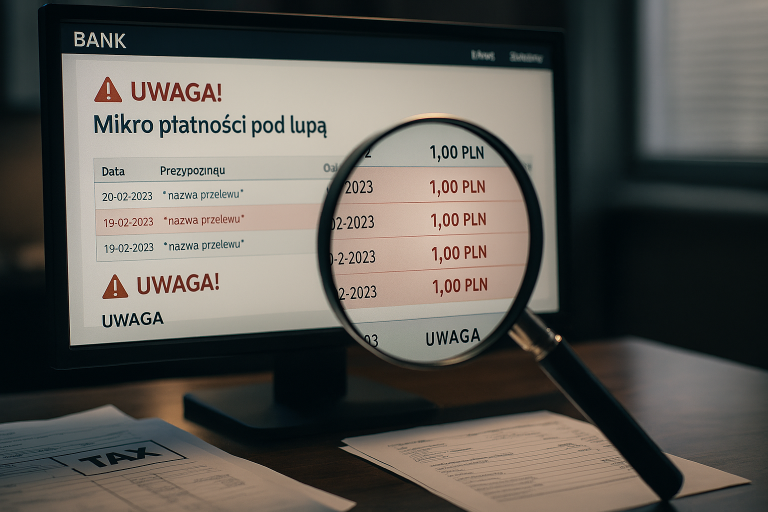
Every business owner knows that running a company is not just about issuing invoices and serving clients. It also means making sure your financial flows look logical and consistent with your business profile.
Today not only banks but also the National Revenue Administration (KAS) closely monitor transactions - both large ones and those that seem small but irregular.
📍 What may attract the tax office's attention?
- Large cash deposits - especially one-off deposits with no visible source.
- Sudden changes in turnover - e.g. if a business account normally handles receipts of a few thousand zloty, and suddenly PLN 40,000 appears.
- Foreign transfers - especially when they are not linked to earlier activity.
- Many transfers of similar amounts in a short period, from different senders.
- Frequent transactions between private and business accounts, without documentation confirming their purpose.
The aim here is not to scare you - most businesses operate honestly. The problem arises when flows look "illogical" from the perspective of risk analysis algorithms.
🧠 What is considered safe and transparent?
- Regular receipts from sales, invoices or services.
- Transfers between related accounts (e.g. company - director) with a proper description and source document.
- Transactions documented by a contract or invoice, even if the amount is high.
- Gifts or loans reported in line with the regulations, if they are of a private nature.
🔍 What does this mean for a business owner?
For many business owners, the key point is to understand that transaction analysis is now part of the financial security system.
It is not about punishment, but about preventing money laundering and the financing of unlawful activity.
That is why it is worth running your business so that every larger transaction has a clear source and justification.
From a practical point of view:
- document every larger receipt or payment,
- describe transfers in an understandable way ("payment for services", "advance for project"),
- keep invoices, statements and business accounts consistent,
- for transfers from abroad - keep confirmation of the source of funds.
🧾 A practical example
Imagine a company that normally operates locally and suddenly starts receiving transfers from accounts in various countries. For an official or a bank algorithm, this may be a warning sign - even if everything is legal.
That is why it is crucial to describe such operations properly and have documentation at hand confirming their nature.
💡 How to protect yourself from unnecessary questions?
- Keep things transparent - every transaction should have a logical explanation.
- Do not mix business and private accounts - this is one of the most common reasons for inspections.
- Keep evidence of the source of funds - invoices, contracts, business correspondence.
- Consult your accountant or adviser on larger transactions - this will help you avoid misinterpretation.
🧭 Summary
Not every unusual financial operation means trouble. But in a world where banks and tax authorities use automated risk analysis, it is worth acting in advance.
Transparency today is not only a matter of regulations, but part of building your company's credibility.
👉 If you want to be sure that your finances are safe and compliant with the regulations - contact us.
We will help you organise your accounting, transfers and financial policy so that your company operates without stress or risk.
Have a question about this?
The first consultation is free - let us talk about your situation.