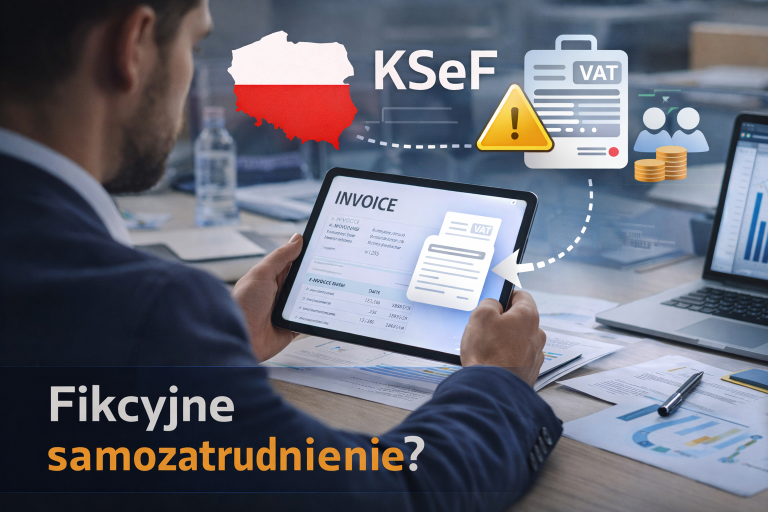
The era of „hit and miss” inspections is coming to an end. Officials are gaining powerful technological support in the fight against abuse in the labour market. The Social Insurance Institution (ZUS) is finalising work on an advanced algorithm that will tell the National Labour Inspectorate (PIP) precisely whose door to knock on first. Will your B2B cooperation model stand up to a digital analyst?
December 2025 brings groundbreaking news for Polish business owners. As reported by Interia Biznes, cooperation between the Social Insurance Institution (ZUS) and the National Labour Inspectorate (PIP) is moving to a whole new level. The goal is clear: to effectively eliminate the practice of disguising employment relationships as B2B contracts.
An algorithm instead of a tip-off - how does the new system work?
Until now, PIP inspections have often relied on reports (tip-offs) or been carried out at random. The latter were frequently ineffective - inspectors wasted time verifying companies that were operating lawfully. That is now set to change.
ZUS, which holds a gigantic database of contributors, is creating a scoring mechanism. The algorithm will analyse millions of records and pick out specific patterns that, with mathematical probability, point to so-called sham self-employment. PIP will therefore receive a „ready-made” list of entities with a high risk of irregularities.
As Sławomir Wasilewski, a member of the ZUS management board, notes, the system will allow inspections to be targeted precisely, working like „a sniper, not artillery”.
Red flags - what will the algorithm check?
Although the exact technical parameters of the algorithm remain a secret of the authority, employment and tax law experts - including specialists from Global Tax Partners - point to the key risk factors that the system will easily detect:
- Invoice monoculture: Issuing only one invoice a month, always to the same client.
- Employee -> B2B transformation: Providing services to a former employer immediately after changing the form of employment (especially where the scope of duties remains the same).
- Features of an employment relationship: Continuity of cooperation, a defined place and time for performing tasks and - most importantly - subordination to the employer.
For the algorithm, these are simple numerical and relational data. If the system notices that „entrepreneur” X issues invoices exclusively to company Y, and has done so for years in the same amounts and at the same times, the risk of inspection rises dramatically.
Is this the end of B2B in Poland?
Absolutely not. A B2B contract remains a fully lawful and attractive form of cooperation, provided that it reflects genuine business relationships. The problem is not the contract itself, but its façade nature.
Business owners who have based their business model solely on optimising labour costs by „pushing” employees into self-employment must brace for a shock. The consequences of reclassifying the contract as an employment contract are painful: the obligation to pay back ZUS contributions (up to 5 years back) together with interest, as well as tax adjustments.
Time for an audit - before the inspector knocks
The introduction of automatic data exchange between ZUS, PIP and the National Revenue Administration (KAS) is a process being accelerated, among other things, by funds from the National Recovery Plan (KPO). This means there is little time to react.
At Global Tax Partners we recommend a proactive approach:
- Reviewing contracts: Do the provisions of your B2B contracts contain elements characteristic of an employment contract (e.g. the right to paid leave, subordination to a superior)?
- Analysing the actual situation: Does the way services are performed in the office differ from what the contract says?
- Securing procedures: Do your B2B contractors have genuine freedom in carrying out assignments?
Are you ready for digital verification?
Technology has no feelings, does not get tired and will not overlook anomalies in the data. The ZUS algorithm will not negotiate - it will simply send a signal to the inspector.
Ask yourself one key question: If your company were to appear on an algorithm-generated list tomorrow, would your documentation and business reality stand up to an inspection?
If even a shadow of doubt has crossed your mind, now is the best time to act. Do not wait for the system to pick you out.
👉 Contact the experts at Global Tax Partners. We will analyse your employment structure, identify areas of risk and help you implement solutions that will keep your business safe in the new, digital tax reality.
Have a question about this?
The first consultation is free - let us talk about your situation.